
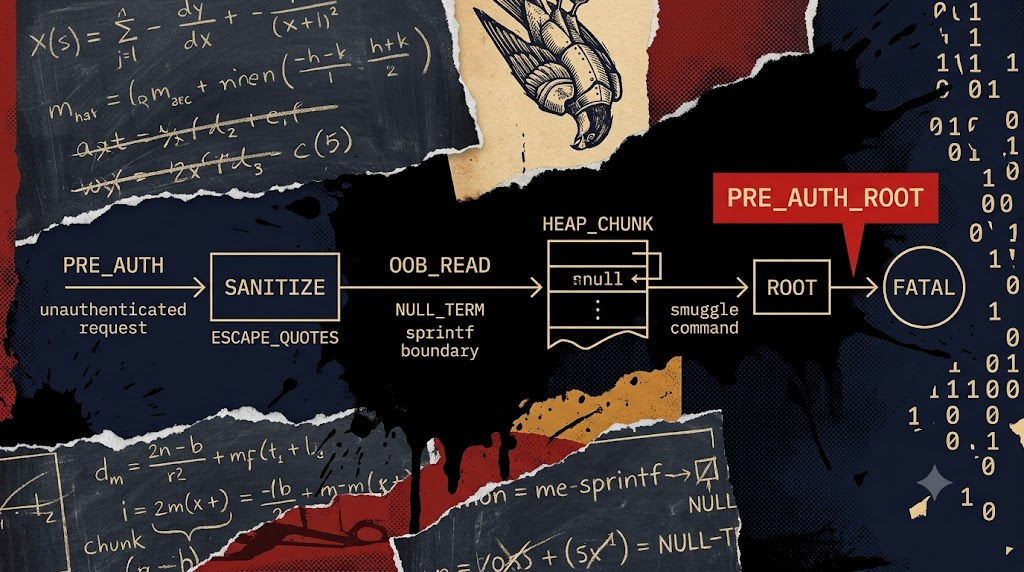
Analysis
CVE-2026-8037 is a pre-authentication remote code execution flaw in Progress Kemp LoadMaster, the widely deployed load-balancing appliance. An unauthenticated attacker who can reach the appliance's API can run arbitrary commands as root by sending a single crafted request. ZDI rates it 9.8 on CVSS. watchTowr Labs published a full technical exploit chain on June 29, 2026, and per eSentire, exploitation attempts began the same day. As of July 3 it is not yet on the CISA KEV catalog — which, given a public exploit write-up and active attempts, makes it a "patch ahead of the KEV" item.
What we know
- 2026-06-29 — watchTowr Labs publishes a detailed write-up walking through the full exploit chain for CVE-2026-8037. eSentire reports active exploitation attempts commencing the same day.
- 2026-07-01/02 — The Hacker News and SC Media report the flaw is being targeted in the wild.
- 2026-07-03 — CVE-2026-8037 is not present in the CISA KEV catalog (cisagov mirror) as of this writing; the "actively exploited" characterization rests on vendor/tier-1 reporting, not CISA listing.
Source-layer flag: exploitation-attempt claims are reported from eSentire and tier-1 press; the vulnerability mechanics below are reported from watchTowr's analysis. Neither has been independently reproduced in our environment. Because this is not KEV-listed, treat "actively exploited" as credible-but-unconfirmed by CISA.
Technical analysis
The vulnerability lives in a function named escape_quotes(), which is meant to sanitize user input before it is passed into a shell command. Per watchTowr's analysis, the escaped output buffer is not null-terminated. If an adjacent, freed heap chunk contains an unescaped command-injection payload with no null byte, sprintf keeps reading out of bounds into that neighboring chunk — smuggling extra command content past the sanitizer and into the final shell string. The result is command injection that runs as root, reachable without authentication when the appliance API is enabled.
The fix swaps the memory-allocation call from one that leaves the buffer uninitialized to one that zero-fills it, and adds an explicit null terminator after the escaped output — closing the out-of-bounds read that made the smuggling possible.
Source-layer flag: the escape_quotes()/uninitialized-heap mechanism and the patch behavior are reported from watchTowr Labs, not independently verified against the binary here.
Load balancers sit in front of everything and terminate a lot of trust. A pre-auth, root-level RCE on the appliance is a full-tenant compromise primitive: traffic interception, credential capture, and a pivot into whatever the LoadMaster fronts.
Indicators of compromise
Affected versions: LoadMaster GA v7.2.63.1 and older, and LTSF v7.2.54.17 and older, when the API is enabled.
Fixed versions: GA v7.2.63.2, LTSF v7.2.54.18.
Precondition: the appliance API must be enabled and reachable by the attacker.
No public C2/hashes: post-exploitation is actor-defined; a working exploit chain is public (watchTowr), so assume commodity availability. Hunt on behavior.
Detection and mitigation
- Patch to GA v7.2.63.2 / LTSF v7.2.54.18 immediately — a public exploit exists and attempts are reported; do not wait for a KEV listing.
- Restrict API exposure: if the LoadMaster management API does not need to be internet-facing, firewall it to an admin network or VPN. This blunts the attack even before patching.
- Hunt the appliance for unexpected root processes, new/modified files, cron entries, or outbound connections that post-date the exposure window (from 2026-06-29 onward).
- Review LoadMaster and upstream logs for anomalous API requests preceding any of the above; assume the appliance may already be compromised if it was internet-facing and unpatched after June 29.
- Rotate any secrets the appliance holds or terminates (TLS keys, backend credentials) if compromise cannot be ruled out.
Attribution
No threat actor is attributed. eSentire characterizes the activity as exploitation attempts; watchTowr's contribution is the vulnerability analysis and exploit chain, not actor tracking. What is claimed: a public exploit exists and the flaw is being targeted. What is not claimed: who is behind the attempts or their objective. Confidence that the vulnerability is exploitable is high (public chain); confidence in any actor identity is unknown. A CISA KEV addition would upgrade the exploitation claim from vendor-reported to government-confirmed and impose a federal deadline.
Criminal-market signal
Bounded negative (evidenced): on 2026-07-03 we swept ~25 dark-web search engines over Tor for CVE-2026-8037 and escape_quotes; ~216 pages were crawled and zero were flagged relevant — no exploit listing or sale post found on the venues our pipeline can see (closed forums and Telegram are out of scope). That said, the exploit-availability signal does not depend on a marketplace: watchTowr published a full exploit chain the same day exploitation attempts began, which collapses the window between disclosure and commodity weaponization to essentially zero. Appliance pre-auth RCEs with public write-ups have a strong history of mass-scanning follow-through; expect opportunistic internet-wide exploitation of unpatched, API-exposed LoadMasters rather than a discreet for-sale listing.
CISO translation
A flaw in our Progress Kemp LoadMaster load balancers lets an attacker on the network take full control of the appliance without any login, and working attack code is already public. This is serious because load balancers sit in front of our applications and hold the keys to a lot of traffic — owning one is close to owning everything behind it. Patch every LoadMaster to the fixed version now and, if its management API is reachable from the internet, firewall it off today. Confidence is high that this is exploitable and being probed (public exploit plus a security vendor reporting attempts), with the one caveat that it is not yet on CISA's official actively-exploited list — so we should act ahead of that, not wait for it. The cost of inaction is an attacker with root on the device that fronts our services: silent traffic interception, credential theft, and a launchpad into the internal network.