
Analysis
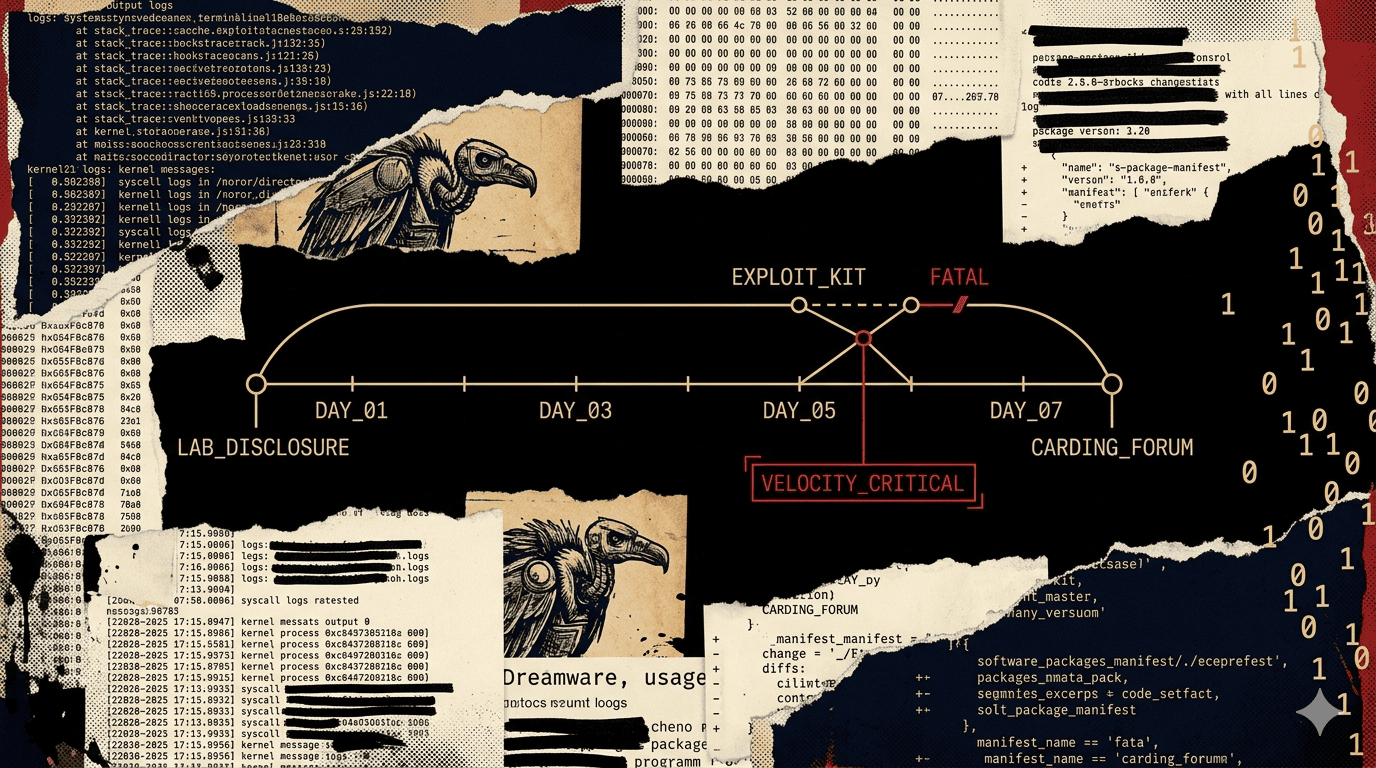
CVE-2026-31431 — codenamed Copy Fail — was disclosed on April 22, 2026. Eight days later, on April 30, it was an active thread on the Exploits section of a long-running carding forum, posted by an established forum member alongside cracked Cobalt Strike binaries and similar commodity offensive tooling. Seven-to-eight days from researcher disclosure to criminal-forum chatter is fast — and the speed itself is the defensible insight. The criminal market made its judgment about CopyFail before most enterprise patch cycles will have started. It picked correctly. Defenders should take that judgment seriously and prioritize accordingly.
What we observed
- April 22, 2026 — CVE-2026-31431 disclosed by Xint.io and Theori. CVSS 7.8, Linux kernel local privilege escalation via the
algif_aeadin-place AEAD optimization. 732-byte Python exploit, four-byte page-cache write, cross-container. Affects every Linux distribution shipped since August 2017. - April 30, 2026 — A thread titled
[0-Day] CVE-2026-31431 – CopyFail: Linux Local Privilege Escalationappears on the Exploits section of an established carding forum. Posted by a forum member with prior activity on the same site (social-engineering threads, other tooling discussion). The thread sits in the same section as cracked Cobalt Strike and similar commodity criminal tooling, not in a research-mirror or news-aggregator section.
The forum's organization is the signal. The thread is in "Exploits" alongside commodity criminal tooling, not in "News" alongside research summaries. That's an opinion the forum is expressing about how the bug will be used.
Why CopyFail crossed and Cursor didn’t
Earlier this month a comprehensive dark-web sweep across the AI-IDE threat surface — nineteen Cursor IDE CVEs disclosed over eight months, multiple GlassWorm-class extension supply-chain compromises, the OpenVSX registry flaws — returned a clean negative. No criminal-market interest, no broker pricing, no observable trade volume. Same pipeline, same engines, same baseline databases.
CopyFail is the same age as the latest Cursor CVEs — disclosed in the same month — and it crossed in a week. The difference isn't pipeline coverage. It's bug economics:
- Reusable primitive vs research-grade chain. CopyFail is a four-byte arbitrary write into the page cache that works deterministically across every modern Linux distribution. It composes with literally any other foothold — webshell, container compromise, low-privilege CI runner, malicious dependency that achieved code execution. The Cursor bugs require the victim to be running Cursor, against a specific repository, in a specific configuration. One is a building block; the other is a niche.
- Cross-container blast radius. The page cache is shared across containers on the same host. Criminal tooling targets Kubernetes nodes, shared CI runners, container-as-a-service platforms — exactly the multi-tenant environments where this primitive is most valuable. Cursor is a developer endpoint. The criminal market doesn't run a developer endpoint targeting business.
- Ransomware operator demand. Linux LPE is a recurring shopping list item for ransomware operators who need to escalate from initial-access foothold to host-level encryption authority. CopyFail fits the role exactly. Cursor exploits don't fit any operator's workflow that exists today.
- Reliability properties. The published exploit needs no kernel offset leak and no race condition. That makes it weaponizable by operators who don't have the engineering depth to handle exploits with environment-dependent reliability. Lowering the operator skill floor is what drives commoditization.
Time-to-criminalization as a patch-prioritization signal
Most security teams patch by CVSS, sometimes by CISA KEV, occasionally by a hunch about exploit prevalence. None of those reflect what the criminal market is actually doing. CVSS 7.8 vs CVSS 9.8 doesn't tell you whether a bug will be in a stealer family in three months. KEV tells you the bug is already exploited in the wild — useful, but late. Time-to-criminalization is an earlier signal: it shows you which research disclosures the criminal market is choosing to invest in, before the in-the-wild exploitation builds enough volume to land on KEV.
The framework is simple:
- Crossed within days — criminal market sees commodity value. Patch on emergency cadence regardless of CVSS. Expect downstream incorporation into stealer / loader / ransomware tooling within weeks.
- Crossed within months — niche or specialized value. Patch on normal cadence. Expect incorporation into specific operator workflows (initial access brokers, specific ransomware affiliates).
- Hasn't crossed in a quarter — research-grade. Likely never commoditizes. Patch on routine cadence; deprioritize against bugs that have crossed.
CopyFail is in the first bucket. Patch this week. The recent npm registry compromise (CVE-2026-12091) is also in the first bucket because the implant work is already done — the postinstall script is the payload. The Cursor cluster is in the third bucket and arguably never reaches the second. The patching urgency is opposite to the order CVSS would give you.
What the carding forum tells you about the operator playbook
The forum's section structure tells you who's reading the thread and what they intend to do with the exploit. CopyFail showed up in "Exploits" alongside cracked Cobalt Strike, social-engineering walkthroughs, and commodity infostealer source code. That's the operator demographic — not nation-state, not research-grade APT, not bug-bounty hunters. Mid-tier criminal operators looking for a portable, reliable Linux LPE to bolt onto whatever initial-access mechanism they already have.
The expected progression from this point, based on prior Linux LPE patterns:
- Weeks 1–2 — exploit code circulates in private/paid threads. Expect a Metasploit module, a clean public PoC, or both within ten days.
- Weeks 2–6 — incorporation into established malware loaders. The four-step exploit (open AF_ALG socket, build payload, splice into target page cache, execve setuid) is short enough to drop into a Go or Rust loader without major engineering work.
- Months 1–3 — appearance in observed ransomware deployments where Linux is in the kill chain (VMware ESXi adjacent infrastructure, Linux file servers, Kubernetes nodes during lateral movement).
- Months 3–6 — possible KEV listing as in-the-wild exploitation accumulates enough vendor incident-response cases to reach the threshold.
This is the standard Linux page-cache LPE arc. Dirty Pipe (CVE-2022-0847) followed it. Copy Fail is structured to follow it faster because the primitive is more reliable.
What defenders should do this week
- Patch the kernel everywhere — Amazon Linux, Debian, RHEL, SUSE, Ubuntu have advisories out as of disclosure date. Reboot or live-patch as appropriate.
- Audit the AF_ALG attack surface. Most application workloads do not use the kernel cryptographic socket interface. A seccomp filter denying
socket(AF_ALG, ...)closes the exploit path for that workload regardless of patch state. This is the right defense-in-depth layer for any container runtime that doesn't strictly require AF_ALG, and it survives the next page-cache LPE in the same class. - Inventory setuid binaries. Reduce the count where you can. Fewer setuid targets means fewer easy exploitation endpoints for any future page-cache write primitive — and there will be more in this class. Page-cache writes have become a recurring Linux LPE shape; treat the primitive as a category rather than a specific bug.
- Treat your multi-tenant Linux hosts as the priority surface. Kubernetes nodes with mixed-trust workloads, shared CI runners, container-as-a-service platforms, bastion hosts. The cross-container property of this primitive turns an in-container compromise into a host compromise; that's the business case the carding-forum readers are evaluating.
The takeaway
You can spend a lot of time speculating about which CVEs will and won't matter. The criminal market does the same exercise with money on the line, and it publishes its conclusions, in plain text, on forums you can read. CopyFail crossed in a week. That's the answer to "is this one of the serious ones." When time-to-criminalization is days, it doesn't matter what your normal patch cadence is — you have already lost the timing argument with the people building tooling against the bug. Patch.